
Pilot filter press testing
The goal of a pilot test is to collect the data needed to size a full-scale filter press correctly. We run your slurry on our pilot press before you commit to equipment.
What we measure
- Cake solids
- How dry the cake gets, and so your disposal or recovery cost
- Cake density
- Sets the chamber volume, and so the press size
- Total cycle time
- Filtration, cake wash, final squeeze and air blow
- Filtrate suspended solids
- Whether the filtrate meets your spec
- Slurry feed solids & pH
- The conditions the press will see in service
- Chemical dosing
- Actual ferric, lime or polymer doses needed
- Maximum operating pressure
- Whether a 7, 15 or 30 bar press is needed
- Cake release & cloth condition
- Which filter cloth to specify
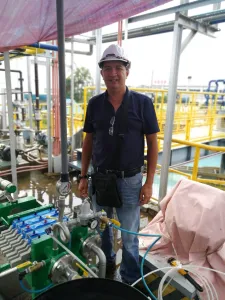
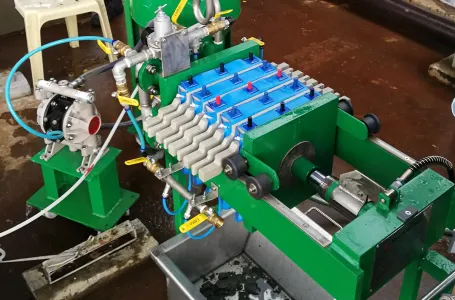
The equipment
Our pilot unit is a sidebar filter press with a manual hydraulic pump: frame, hydraulic system, and filter plates with cloths chosen to suit your application. A test also uses feed pumps and mixing tanks with mixers.
Recessed chamber test
Filter press, feed pump(s), and mixing tank with mixer.
Membrane test
Everything above, plus a compressed gas supply for the membrane squeeze.
How a test runs
- 1
Prepare
Condition the sludge or slurry as needed and fit the correct plates and filter cloth.
- 2
Fill
Start the feed pump and fill the press. Once filtrate appears, start timing and take filtrate samples.
- 3
Filter
Continue until both the low-flow and maximum-pressure conditions are reached. A recessed chamber test ends here.
- 4
Wash, squeeze, blow
For a membrane test: optional cake wash, membrane squeeze and optional air blow-down.
- 5
Open and sample
Open the press, remove the cake and take cake samples. Note how the cake releases and the condition of the cloth.
Choosing the filter cloth
Each cloth style has its own weave pattern, yarn, surface finish, porosity, thread count, weight and material. We prefer to use as open a cloth as possible, since the cake, not the cloth, does most of the filtering. On most sludges, relatively open monofilament fabrics give the best cake release.
The two criteria are initial filtrate quality (assuming the sludge is properly conditioned) andcake release. Process applications often accept somewhat poorer cake release for cleaner filtrate; waste applications usually accept slightly dirty initial filtrate for better release. Both experience and trial and error go into the choice.
Conditioning chemicals
Chemicals for conditioning are chosen by jar tests before the pilot run.
| Chemical | Typical form |
|---|---|
| Ferric chloride | Supplied as a solution |
| Lime | Slurried at about 10% w/w |
| Polymer | Solutions of about 0.1 – 0.25% |
| Others | Added as solutions or slurries |
Book a pilot test
Tell us about your slurry: what it is, roughly how much you process and what you need from the cake and filtrate. We'll plan the test with you.